
The Last Mile of a Seizure: Why Confiscated Materials Should Be Destroyed Where They’re Caught
A look at the destruction burden facing law enforcement in Yuma County, Arizona and Imperial County, California — and what changes when the incinerator is 30 miles away instead of 800.
Every seizure has a second half
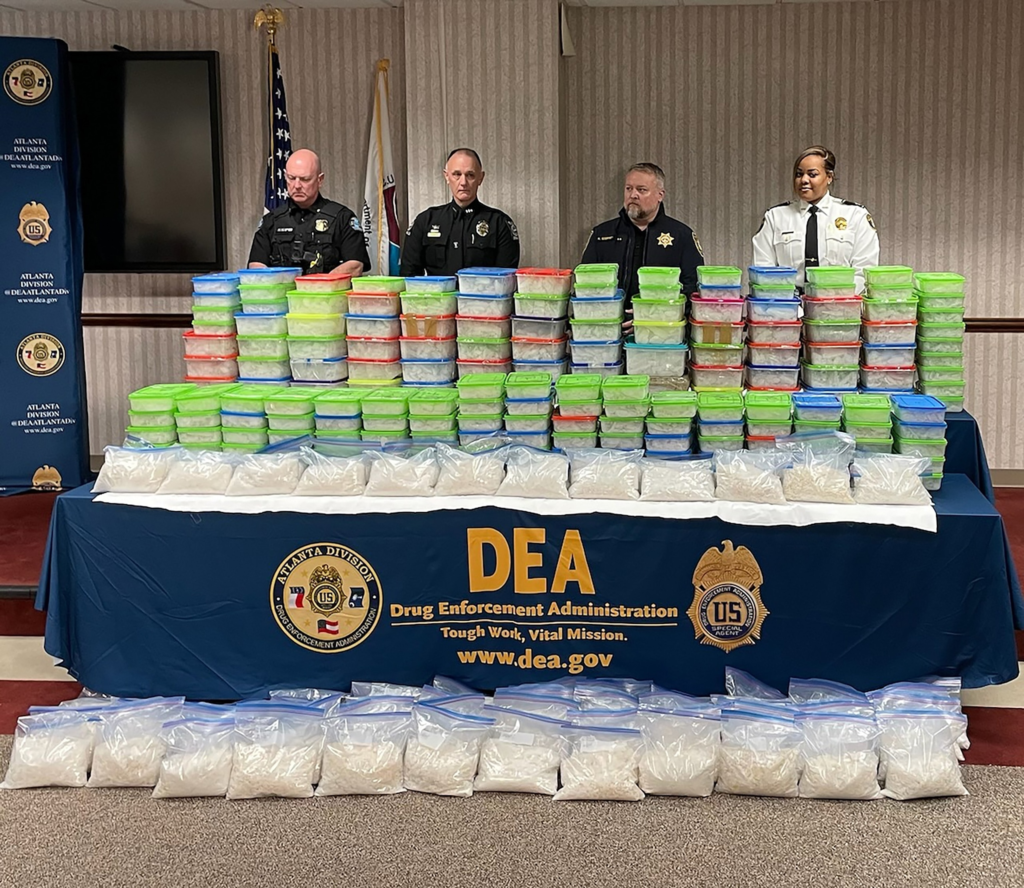
A seizure makes the news on the day it happens. Agents open a rocker panel at the Interstate 8 checkpoint, a canine alerts at Calexico West, officers pull forty packages out of a tailgate at San Luis. The press release goes out, the weight and street value get published, and the story ends.
It doesn’t actually end there. Every pound of that material still exists. It sits in an evidence locker through charging, discovery, plea negotiations, trial, and appeal — and then, once the case releases it, somebody has to destroy it. Permanently, verifiably, and under federal rules that don’t leave much room for improvisation.
That second half of the job is invisible, expensive, and — in this particular corner of the Southwest — getting harder every year.
How much material are we talking about?
There is no single public dataset that reports “pounds of contraband awaiting destruction in Yuma and Imperial counties.” The destruction stream has to be assembled from the seizure reporting of every agency that feeds it. Here is that build-up, with the reported figures that anchor each line.
The federal interdiction agencies
U.S. Border Patrol, Yuma Sector. Yuma Sector’s totals swing hard with migration patterns and checkpoint staffing. Agents seized nearly 6,750 pounds of drugs in FY 2020 — including more than 84 pounds of cocaine, 18.5 pounds of heroin, over 1,900 pounds of methamphetamine, and 107.48 pounds of fentanyl — then saw the total fall to 2,021 pounds in FY 2021 as apprehensions surged.[^1] Sector leadership has since described interdictions trending back up, attributing much of the increase to checkpoints returning to full operation.[^2]
U.S. Border Patrol, El Centro Sector. El Centro is one of the country’s heaviest methamphetamine corridors. In FY 2019 the sector seized 199 pounds of marijuana, 61 pounds of cocaine, 2,684 pounds of methamphetamine, over 1,617 ounces of heroin, and 39 pounds of fentanyl[^3] — roughly 3,100 pounds in a single year from one sector.
CBP Office of Field Operations at the ports. San Luis I and II, Andrade, and Calexico West and East generate their own independent stream, and the individual events are not small. Calexico officers pulled 427 packages of methamphetamine weighing 861.96 pounds from a single non-factory compartment during one February week.[^4] At San Luis, officers working a single weekend seized 1,000 rounds of ammunition and over 285 pounds of hard narcotics across a series of interceptions.[^5]
The state, county, and municipal agencies
Yuma County’s narcotics work runs through the Yuma County Narcotics Task Force, which is led by the Yuma County Sheriff’s Office and includes San Luis PD, Somerton PD, Border Patrol, DEA, HSI, Yuma PD, and the County Attorney’s Office.[^6] On the California side, the Imperial County Sheriff’s Office, El Centro PD, Calexico PD, Brawley PD, CHP, the Imperial Valley HIDTA team, and California DOJ all book evidence that eventually needs disposal. The scale of what passes through them is visible in the takedowns: one Imperial Valley case alone accounted for more than 3,600 kilograms — about 8,000 pounds — of methamphetamine plus substantial quantities of fentanyl, cocaine, and heroin.[^7]
Rolling it up
| Source | Estimated annual net weight |
| USBP Yuma Sector | 2,000 – 7,000 lb |
| USBP El Centro Sector | 2,000 – 4,000 lb |
| CBP OFO — San Luis I/II, Andrade | 1,500 – 4,000 lb |
| CBP OFO — Calexico West/East | 1,500 – 4,000 lb |
| State, county & municipal agencies | 1,000 – 3,000 lb |
| Net narcotic weight | 8,000 – 22,000 lb |
Net drug weight is not shipping weight. Material arrives for destruction inside what it was smuggled in: vacuum-sealed wrapping, electrical tape, absorbents, evidence packaging, and seized paraphernalia. A two- to three-fold multiplier on net weight is a conservative assumption, which puts the narcotics stream alone at roughly 8 to 33 tons per year.
Then add the non-narcotic contraband that also requires permitted thermal destruction:
- Prohibited agricultural intercepts. San Luis, Andrade, and Calexico are high-volume land ports. Nationally, CBP agriculture specialists seized 4,552 prohibited plant, meat, animal byproduct, and soil items on a typical day in FY 2018.[^8] Standard practice is destruction — items are seized, inspected for pests and disease, and destroyed.[^9]
- Counterfeit and IPR-infringing goods ordered destroyed after forfeiture.
- Prescription take-back collections, held twice yearly at multiple sites in both counties.
- Illicit cannabis. California’s Unified Cannabis Enforcement Task Force has seized and destroyed more than 841,000 pounds of illicit cannabis since 2022, including over 63,000 pounds between April and June 2026 alone.[^10]
Bottom line: a defensible working estimate is 12 to 50 tons of material per year across the two-county region requiring permitted, witnessed, non-retrievable destruction.
(Ranges are modeled from published seizure reporting rather than from destruction manifests. Firming them up would require records requests to the individual agencies — a worthwhile exercise before any capacity commitment.)
Where does it go today? Nowhere close.
Here is the problem in one sentence: this region sits in a destruction desert, and the desert just got bigger.
California used to have the answer. For decades, agencies statewide relied on two waste-to-energy plants — the Southeast Resource Recovery Facility in Long Beach and the Covanta/Reworld facility in Crows Landing, Stanislaus County. Departments would load into armored convoys and drive to Crows Landing, a town of 212 people, to destroy drugs in what had become the state’s last trash incinerator.[^11] Both facilities closed permanently by the end of 2024.[^12]
The consequences were immediate and — remarkably — required the U.S. Air Force to solve. In May 2026, the 433rd Airlift Wing flew a C-5M Super Galaxy carrying 23 pallets, roughly 50 metric tons, of seized narcotics from March Air Reserve Base in California to Wright-Patterson AFB in Ohio, from which the material moved to an incinerator in Indiana for final destruction.[^13] The DEA was explicit about why: recent environmental closures of major California incinerators had left the agency with growing stockpiles, and without airlift support it would have had to drive the material across several states — consuming manpower and time while raising the risk of ambush, theft, or logistical failure.[^14] A DEA official summarized the stakes plainly, noting that drug evidence is street currency and that moving it is by definition a high-security mission.[^13]
That was a federal agency with access to strategic airlift. Local departments have pickup trucks.
For agencies in Yuma and Imperial counties, the realistic permitted options are all far away:
| Destination | Approx. one-way drive | Round trip |
| Clean Harbors, Aragonite, UT | ~780 mi from Yuma | ~1,560 mi |
| Clean Harbors, Aragonite, UT | ~845 mi from El Centro | ~1,690 mi |
| Crows Landing, CA (closed Dec 2024) | ~500 mi from El Centro | ~1,000 mi |
| Indiana-area incinerator | ~1,950 mi from Yuma | ~3,900 mi |
Clean Harbors’ western incineration capacity is concentrated at Aragonite, Utah, with its other U.S. incinerator facilities in Kimball, Nebraska; Deer Park, Texas; and El Dorado, Arkansas.[^15] There is nothing closer.
The escort is not optional
This is where distance stops being an inconvenience and becomes a budget line.
Federal regulation dictates the staffing. Under 21 CFR § 1317.95, when controlled substances are transported to a registered location for destruction, transportation must be direct — the substances constantly moving toward their final location, with no unnecessary or extended stops — and two employees of the transporting registrant must accompany the substances, load and unload them, and personally witness the destruction until the material is rendered non-retrievable.[^16] The governing standard is that all controlled substances be rendered non-retrievable, specifically to prevent diversion to illicit purposes and to protect public health and safety.[^17]
Two sworn personnel. Direct routing. Present through the burn. For an 800-mile haul, that is a multi-day commitment.
What one convoy actually costs
Modeling a Yuma-to-Aragonite round trip with two officers in two vehicles, a $75/hour fully loaded personnel rate, and the federal POV mileage rate of 72.5 cents per mile in effect for the first half of CY 2026:[^18]
| Line item | Out-of-region (Aragonite) | Local (in-region) |
| Round-trip miles | ~1,560 | ~70 |
| Officer duty hours | ~31 (≈4 days) | ~4 (same day) |
| Vehicle cost | ~$2,260 | ~$100 |
| Personnel cost | ~$4,700 | ~$640 |
| Lodging & per diem | ~$1,250 | $0 |
| Total per trip | ~$8,200 | ~$740 |
Roughly $7,500 saved per shipment — before the destruction fee itself.
Across a region generating 15 to 25 escorted destruction runs a year, that scales to $110,000 to $190,000 annually in avoided escort cost, and it eliminates roughly 23,000 to 42,000 highway miles of contraband transport.
Just as valuable: those trips consume between 1,000 and 1,700 officer-hours per year — the equivalent of half to four-fifths of a full-time position spent driving to Utah. Local destruction converts that into a half-day errand and returns the rest to patrol, investigations, and interdiction.
The road risk you don’t get back
The safety argument deserves an honest accounting rather than an inflated one.
Using NHTSA’s 2024 figures — 6,180,241 police-reported crashes and 39,254 traffic fatalities at a rate of 1.19 per 100 million vehicle miles traveled[^19] — the national police-reported crash rate works out to about 1.87 crashes per million miles driven. Eliminating 30,000 escort miles a year is therefore not, by itself, a statistically dramatic intervention: it represents roughly one avoided police-reported crash every 17 years, or about 1.1 crashes and 600,000 fewer exposed miles over a 20-year horizon.
But averages are the wrong lens here, for three reasons.
First, the consequence profile is not average. An ordinary fender-bender is a fender-bender. A collision involving a contraband convoy is a scene with narcotics on a public roadway, a chain-of-custody emergency, a potential hazmat response, and evidence that may become unusable in a pending prosecution. The expected frequency is low; the expected cost per event is not.
Second, crashes are a leading killer of officers. NLEOMF’s year-end data recorded 34 traffic-related law enforcement fatalities in 2025, down from 44 in 2024, second only to gunfire as a cause of line-of-duty death.[^20] Highway miles are not incidental exposure for this profession — they are one of the two things most likely to kill an officer on duty.
Third, road risk is only one of the risks in transit. The federal government’s own assessment of long-haul contraband movement identified ambush, theft, and logistical failure as the security vulnerabilities that motivated moving 50 tons by air rather than by road.[^14] A 70-mile round trip inside the county exposes a shipment to a fraction of the opportunity that a 1,560-mile interstate run does.
Complete destruction is the whole point
The regulatory objective isn’t disposal. It’s irreversibly.
DEA’s non-retrievable standard requires that a controlled substance be permanently altered through irreversible means so that it is unavailable and unusable for all practical purposes[^21] — and the method must be sufficient to render non-retrievable any controlled substance likely to be present, even when what was collected is not precisely known.[^17] That last clause matters enormously for seized contraband, which is by definition an unverified mixture.
High-temperature incineration is the method that reliably delivers that outcome, and the equipment matters. Our facility runs an industrial incinerator built on controlled-air technology paired with a secondary burn chamber — a two-stage design well suited to exactly the kind of mixed, unverified load a contraband seizure produces.
The first chamber operates in a starved-air condition, holding combustion air below what full oxidation would require. Material breaks down under heat rather than burning fast and dirty, which keeps particulate carryover low and turns solids into ash and combustible gases. Those gases pass into the secondary burn chamber, where excess air, sustained high temperature, and controlled residence time complete the oxidation before anything reaches the stack. Nothing exits on the strength of a single pass.
That second stage is what converts a burn into a destruction. Federal standards for permitted incineration require a destruction and removal efficiency of at least 99.99 percent for principal organic constituents,[^22] and a two-chamber controlled-air unit is engineered to hit that mark consistently rather than occasionally. What comes out is inert ash — weighed, logged, and non-retrievable by any definition DEA recognizes.
The design also fits the operational reality of this work. Contraband does not arrive as a clean waste stream: it arrives as product plus vacuum-sealed plastic, tape, foil, absorbents, evidence packaging, and paraphernalia, in whatever proportion the smuggler chose. Controlled-air combustion handles that heterogeneity without the feed-preparation demands heavier industrial systems impose, and the same unit handles the sensitive-records and media stream on the days no seizure is scheduled.
The alternative to a permitted local facility isn’t a shorter drive — historically, it has been improvisation. Before centralized options existed in California, agencies burned confiscated drugs in open desert pits, crematoriums, and hospital incinerators, each department following its own policy in the absence of guidance.[^23] Nationally, the picture was similar: police have used crematories, foundries, hospital incinerators, specialized businesses, and even 55-gallon drums.[^24] When the compliant option is 800 miles away, the non-compliant options start looking practical — and an evidence room that keeps filling becomes a potential theft target in its own right.[^24]
A permitted, witnessed, in-region destruction capability closes that loop. Material that came out of a vehicle at the I-8 checkpoint on Tuesday can be ash, with a signed certificate of destruction, by Thursday. It never accumulates. It never sits on a shelf for eleven years waiting for a convoy slot. It never travels 1,560 miles of interstate with two officers who should be working cases. And it never, under any circumstance, finds its way back onto a street in Somerton or Calexico.
The summary case for local destruction
- Volume justifies it. An estimated 12 to 50 tons per year of narcotics, agricultural contraband, counterfeit goods, and take-back pharmaceuticals across the two counties.
- The nearest permitted alternative is 780+ miles away, and California’s in-state options closed at the end of 2024.
- Federal rules mandate two-officer escort and witnessed destruction, making distance a direct personnel cost.
- Roughly $7,500 saved per shipment; $110,000–$190,000 per year regionally.
- 1,000–1,700 officer-hours per year returned to the field.
- 23,000–42,000 fewer highway miles annually, cutting exposure to crashes, ambush, and theft.
- Controlled-air incineration with a secondary burn chamber meets the 99.99% destruction and removal efficiency standard and DEA’s non-retrievable requirement, with documentation that stands up in audit and in court.
- Evidence lockers stop overflowing — which is a security control, not a housekeeping preference.
Sources
[^1]: U.S. Customs and Border Protection, Yuma Sector drug seizure statistics, FY 2020 and FY 2021.
[^2]: U.S. Customs and Border Protection, Yuma Sector leadership remarks on checkpoint operations and interdiction volume.
[^3]: U.S. Customs and Border Protection, “El Centro Sector Border Patrol Highlights Fiscal Year 2019.” https://www.cbp.gov/newsroom/local-media-release/el-centro-sector-border-patrol-highlights-fiscal-year-2019
[^4]: U.S. Customs and Border Protection, “Three narcotic interdictions by CBP Officers at Calexico Port of Entry result in over $2 million in hard narcotics seized,” February 2024. https://www.cbp.gov/newsroom/local-media-release/three-narcotic-interdictions-cbp-officers-calexico-port-entry-result
[^5]: U.S. Customs and Border Protection, “Port of San Luis CBP Officers Intercept Ammunition and Narcotics,” August 2024. https://www.cbp.gov/newsroom/local-media-release/port-san-luis-cbp-officers-intercept-ammunition-and-narcotics
[^6]: Yuma County Sheriff’s Office, “Narcotics Task Force.” https://www.yumacountysheriff.org/patrol-ntf.htm
[^7]: U.S. Department of Justice, Imperial Valley narcotics trafficking prosecution announcement.
[^8]: U.S. Customs and Border Protection, “CBP Trade and Travel Report” / “On a Typical Day” agriculture seizure statistics, FY 2018.
[^9]: U.S. Customs and Border Protection, agricultural inspection and prohibited-item destruction procedures.
[^10]: California Unified Cannabis Enforcement Task Force, illicit cannabis eradication totals, 2022 through Q2 2026.
[^11]: Published reporting on California law enforcement drug-destruction convoys to the Covanta/Reworld facility at Crows Landing, Stanislaus County.
[^12]: Aerospace Global News, “Operation Burnout: USAF C-5M Super Galaxy hauls $5bn drugs for destruction,” on the 2024 closures of the Southeast Resource Recovery Facility (Long Beach) and Covanta/Reworld Stanislaus. https://aerospaceglobalnews.com/news/usaf-c5m-super-galaxy-dea-drug-transport-operation-burnout/
[^13]: Air Force Reserve Command, “Operation Burnout: 433rd AW Airlifts $5 Billion in Seized Narcotics for Destruction,” July 2026. https://www.afrc.af.mil/News/Article/4534344/operation-burnout-433rd-aw-airlifts-5-billion-in-seized-narcotics-for-destructi/
[^14]: DVIDS, “Operation Burnout: 433rd AW Airlifts $5 Billion in Seized Narcotics for Destruction,” including DEA statements on incinerator closures and overland transport risk. https://www.dvidshub.net/news/569283/operation-burnout-433rd-aw-airlifts-5-billion-seized-narcotics-destruction
[^15]: Clean Harbors, incineration facility network: Aragonite, Utah; Kimball, Nebraska; Deer Park, Texas; El Dorado, Arkansas.
[^16]: 21 CFR § 1317.95, “Destruction procedures.” https://www.law.cornell.edu/cfr/text/21/1317.95
[^17]: 21 CFR § 1317.90, “Methods of destruction.” https://www.law.cornell.edu/cfr/text/21/1317.90
[^18]: U.S. General Services Administration, Bulletin FTR 26-02, CY 2026 Privately Owned Vehicle mileage reimbursement rates. https://www.gsa.gov/policy-regulations/regulations/federal-travel-regulation/ftr-and-related-files/gsa-bulletin-ftr-2602
[^19]: National Highway Traffic Safety Administration, 2024 traffic crash and fatality data.
[^20]: National Law Enforcement Officers Memorial Fund, 2025 End-of-Year Law Enforcement Officer Fatalities Report.
[^21]: 21 CFR § 1300.05, definition of “non-retrievable.” https://www.ecfr.gov/current/title-21/chapter-II/part-1300/section-1300.05
[^22]: U.S. Environmental Protection Agency, destruction and removal efficiency (DRE) performance standards for permitted incinerators, 40 CFR Part 264 Subpart O. Applicable permit conditions and required source-test results vary by unit, waste code, and permitting authority.
[^23]: Published reporting on historical California law enforcement drug destruction practices prior to centralized options.
[^24]: CBS News, “How are authorities destroying seized drugs?” including International Association for Property and Evidence commentary on destruction methods and evidence-room security risk. https://www.cbsnews.com/news/how-are-authorities-destroying-seized-drugs/